$50.00
In stock
| Quantity | Discount (%) | Price |
|---|---|---|
| 1 | — | $50.00 |
| 3 | 4 % | $48.00 |
| 6 | 10 % | $45.00 |
| 12+ | 16 % | $42.00 |
Free bacteriostatic water with every order.
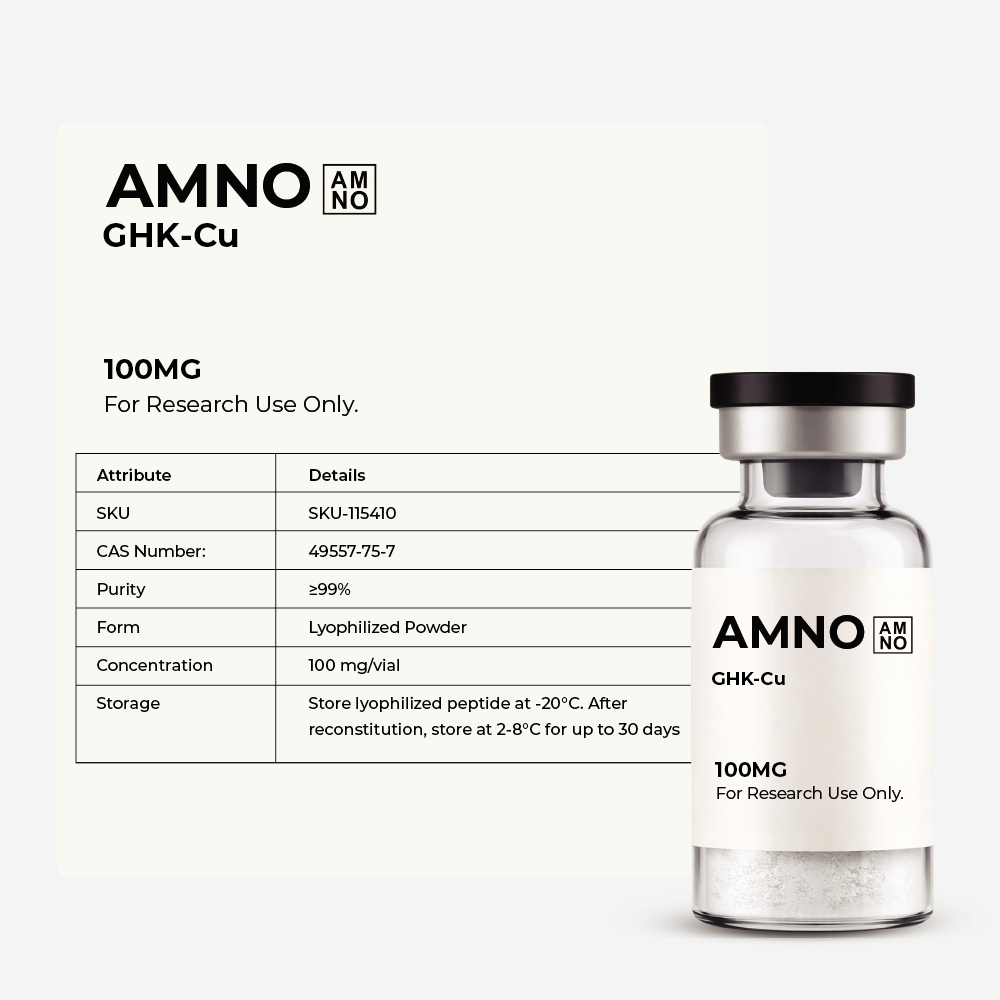
Formula: C14H21CuN6O4
Weight: 404.9 g/mol
CAS: 89030-95-5
Structure: Gly-His-Lys (with bound copper)
Form: Blue crystalline powder (the blue is from the copper)
Solubility: Soluble in water
Natural Occurrence: Found in human plasma, saliva, and urine
Storage: Keep refrigerated 36‑46 °F (2‑8 °C), keep from light
Stimulates production of collagen types I and III to support structural tissue integrity
Binds and delivers copper to enhance enzymatic activity involved in tissue repair
Regulates expression of genes involved in wound healing, antioxidant defense, and extracellular matrix remodeling
Modulates pro-inflammatory cytokines while supporting regenerative pathways
Studied for improving skin elasticity, reducing wrinkles, and enhancing dermal repair
Investigated for accelerating wound closure and improving tissue remodeling quality
Explored for increasing glycosaminoglycan production and improving matrix organization
Evaluated for promoting follicle health and improving microcirculation in dermal models
Research consistently demonstrates GHK-Cu’s ability to improve skin structure and restore youthful gene expression patterns.
Modulates expression of 4,000+ human genes
Upregulates 47 DNA repair genes
31.2% of genes show ≥50% expression change
59% of affected genes upregulated, 41% suppressed
Resets gene expression toward a younger profile
Extensive research shows strong effects on structural proteins and skin integrity.
Increases collagen IV synthesis (up to 25.4-fold with hyaluronic acid, 2023 data)
Stimulates collagen I, III, and elastin production in dermal fibroblasts
Upregulates decorin and glycosaminoglycan production
Modulates matrix metalloproteinases (MMPs) and TIMPs
Restores extracellular matrix integrity in aged and photodamaged skin
Preclinical studies demonstrate enhanced tissue repair and regeneration.
Accelerates wound closure in diabetic and ischemic models
Reduces TNF-β and MMP-2/MMP-9 activity
Stimulates VEGF and fibroblast growth factor production
Increases keratinocyte proliferation and migration
Improves healing outcomes in chronic, non-healing wounds
GHK-Cu shows strong modulation of inflammatory signaling pathways in research models.
Reduces TNF-α–induced IL-6 secretion in fibroblasts
Suppresses NF-κB pathway activation
Decreases pro-inflammatory cytokine expression
Modulates oxidative stress markers
Studied as a potential alternative to corticosteroid-based approaches in models
Emerging research supports effects on follicle biology and scalp health.
Increases hair follicle size in experimental studies
Extends the active growth (anagen) phase of the hair cycle
Improves scalp circulation markers
Shows potential in reversing follicular miniaturization models
Research suggests broader biological influence beyond skin alone.
Endogenous levels decline with age (approx. 200 ng/mL at age 20 vs ~80 ng/mL at age 60)
Improves measurable skin texture and elasticity markers
Enhances collagen and elastin production systemically
Supports tissue tightening and structural improvement in aging models
Injection site reactions in animal models
Rare hypersensitivity responses
Theoretical concern in copper-sensitive subjects
No significant adverse effects reported in studies
The natural occurrence of GHK-Cu in the human body contributes to its excellent tolerability profile.
Independent laboratory testing confirms purity and composition
Purity
Batch
Date